The 70% Rule: Why Nutrition Perfection Backfires
Every January, millions of people start a diet. They download an app, buy the groceries, plan the meals. By February, most have quit. Not because they lacked willpower. Not because the plan was wrong. Because their system demanded perfection. And perfection is a trap.
I've been there. Twice. The second time I quit a tracking app, I didn't open another one for eight months.
The perfection trap
Most nutrition systems work on binary logic. You hit your macros or you didn't. You stayed under calories or you failed. One bad day and the numbers turn red.
That red number does something insidious. It reframes one imperfect day as a personal failure. "I ruined it." Then the shame spiral kicks in. You overeat because what's the point. You stop logging because who wants to document failure. Within a week, the app is collecting dust on your second home screen.
This isn't a character flaw. It's a design flaw. Research on dietary adherence consistently shows that rigid dietary control predicts binge eating and dropout, while flexible control predicts sustained weight management. When a system punishes anything less than perfection, it guarantees its own abandonment.
What is the 70% rule?
MyProtocol uses a phase-based progression system. To advance through phases, your monthly average needs to hit 70%. That's it.
In grade terms, 70% maps to roughly the B-/C+ boundary. Not stellar. Not supposed to be. The system is designed so that a month where you nail it 21 days, coast through 5, and completely blow it for 4 still counts as a win. You advance. You move forward. Progress is logged.
The math: roughly 9 days per month can fall below target. Nine. That's more than two full weeks of weekends. That's a vacation. That's a bad week at work plus a few rough dinners.
And you still advance.
Why 70% specifically
The threshold had to thread a needle.
Set it too high (say 90%) and you're back in perfectionism territory. One rough week torpedoes your month. People disengage the same way they always do.
Set it too low (say 50%) and there's no behavioral pressure at all. You can half-commit and still "succeed," which means the system isn't actually shaping habits.
70% sits in what I call the sustainable zone. High enough that you can't coast. You need to show up most days. But low enough to absorb the things that derail every other system: travel, celebrations, sick days, stressful weeks, the occasional pizza-and-ice-cream evening you don't regret.
Lally et al. (2010) found that missing a single day did not meaningfully affect habit formation. What mattered was the overall frequency. The 70% threshold is built on this principle: consistency matters, individual misses don't.
Phases, not streaks
Most health app gamification revolves around streaks. Log in every day. Hit your target every day. Miss once and your counter resets to zero.
Streaks are psychologically brutal. They punish a single bad day with the same weight as a month of bad days. Your streak is gone either way. And once it's gone, motivation collapses. "I already lost my 30-day streak, why bother starting over?"
MyProtocol doesn't use streaks for progression. It uses phases.
Phases are cumulative. Foundation takes 30 days. Momentum takes 60. Transformation takes 90. Lifestyle takes 180. Each builds on the last.
A bad month can stall your progress. Your phase won't advance if you drop below the threshold. But it never resets. You don't lose the months you already banked. A rough patch means you're paused, not back at zero.
This distinction matters more than it sounds. Resets trigger quitting. Pauses trigger recovery. The psychology is completely different.
What this looks like in practice
Say it's March. You've been tracking for a couple of months and you're in Phase 2.
Week one goes well. You log every meal, protein is on point, food quality is solid. Mostly green days.
Week two, you travel for work. Hotel breakfasts, client dinners, limited options. You log what you can. A couple of yellow days, one red day.
Week three, back home and back on track. Good days stack up again.
Week four, you catch a cold. Two days of barely eating, one day of comfort food.
Final tally: 21 green days, 5 yellow, 4 red. Monthly average lands around 75%. Phase advances. You move on.
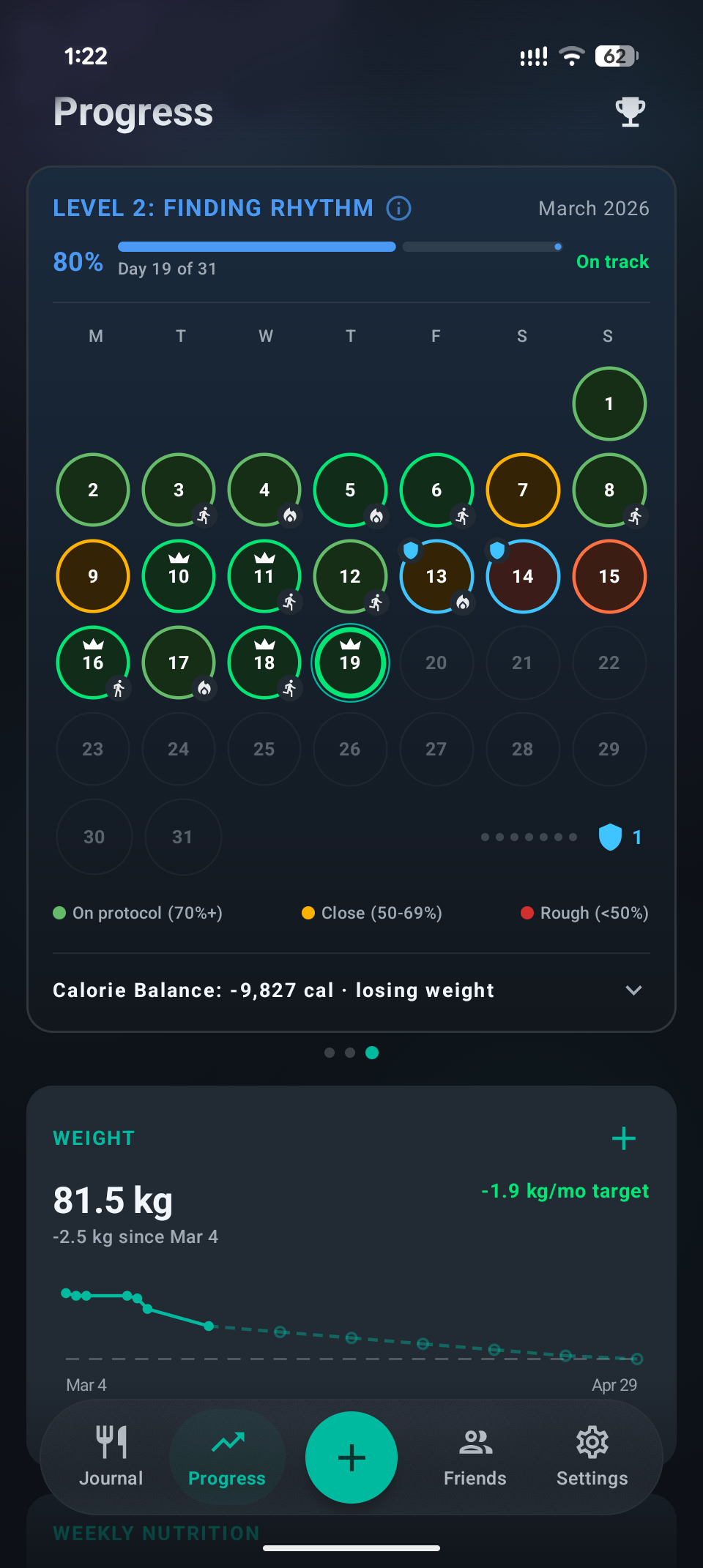
That vacation week? Absorbed. The sick days? Absorbed. Your worst days didn't define your month. Your consistency did.
Consistency beats perfection
There's a version of nutrition tracking that makes people feel bad about themselves. It counts every gram, flags every miss, treats every deviation as a problem to solve. It works for some people, for a while. Then life happens and they stop.
I built MyProtocol around a different idea: consistency beats perfection. Not as a motivational poster, but as an actual system mechanic. The 70% rule means your progress isn't fragile. A bad day is a bad day, not a crisis. A bad week is absorbable.
That's not lowering the bar. That's building a bar you can actually clear, month after month, for the long haul. Which is the only time frame that matters for nutrition anyway.
Like our approach?
MyProtocol scores your meals, coaches you in real time, and adapts to your goals. Get started in two minutes.
