How We Score Your Meals (And Why It's Not About Calories)
Most nutrition apps give you a number. Calories in, calories out. You either hit the target or you didn't. The number doesn't care if those calories came from salmon and roasted vegetables or a gas station hot dog. It just counts.
I think that's a broken way to evaluate a meal. So instead of a number, MyProtocol gives you a grade. And tells you exactly why you earned it.
The grade scale
Every meal receives a compliance score from 0 to 100%, which maps to a letter grade:
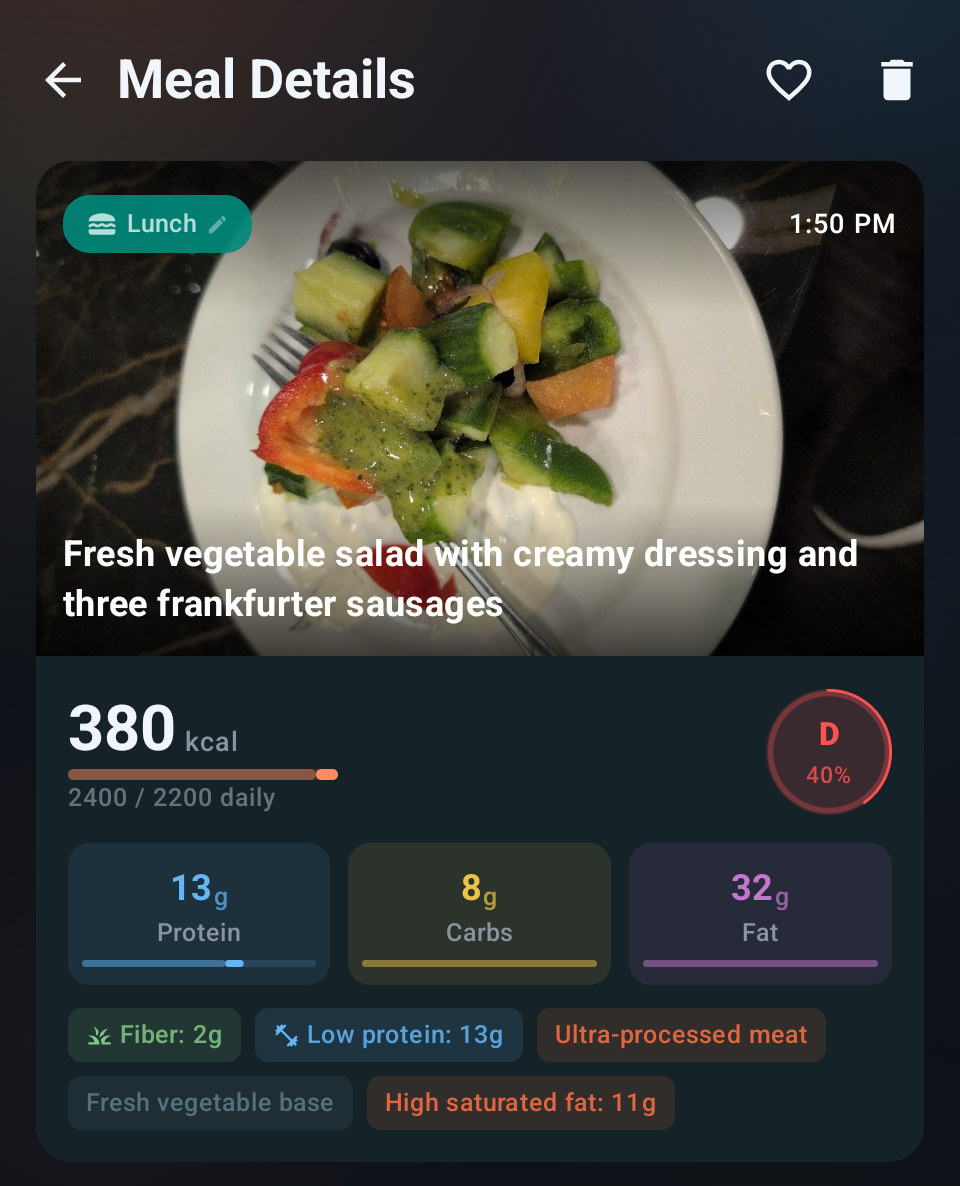
S (95-100%) is exceptional. Protocol-perfect with bonus qualities on top. You don't need to hit S every meal. You probably won't. That's fine.
A+, A, A- (80-95%) is strong adherence. This is the range where real progress lives. Solid protein, good food quality, aligned with your protocol.
B+, B, B- (65-80%) is good enough for progress. Maybe protein was a little light, or there was a moderate processed component. Still moving in the right direction.
C+, C, C- (50-65%) means something was meaningfully off. Low protein density, heavy processing, or a significant mismatch with your protocol. Not catastrophic, but not a pattern you want.
D (40-50%) and F (below 40%) mean something went significantly off-track. These aren't punishments. They're signals. And one bad grade doesn't tank your week.
Twelve grades instead of five. That granularity means the system can distinguish between "slightly under-proteined lunch" and "drive-through dinner." That matters when you're tracking trends over weeks.
What we actually score
Three things determine your grade. Not calorie count. Never calorie count.
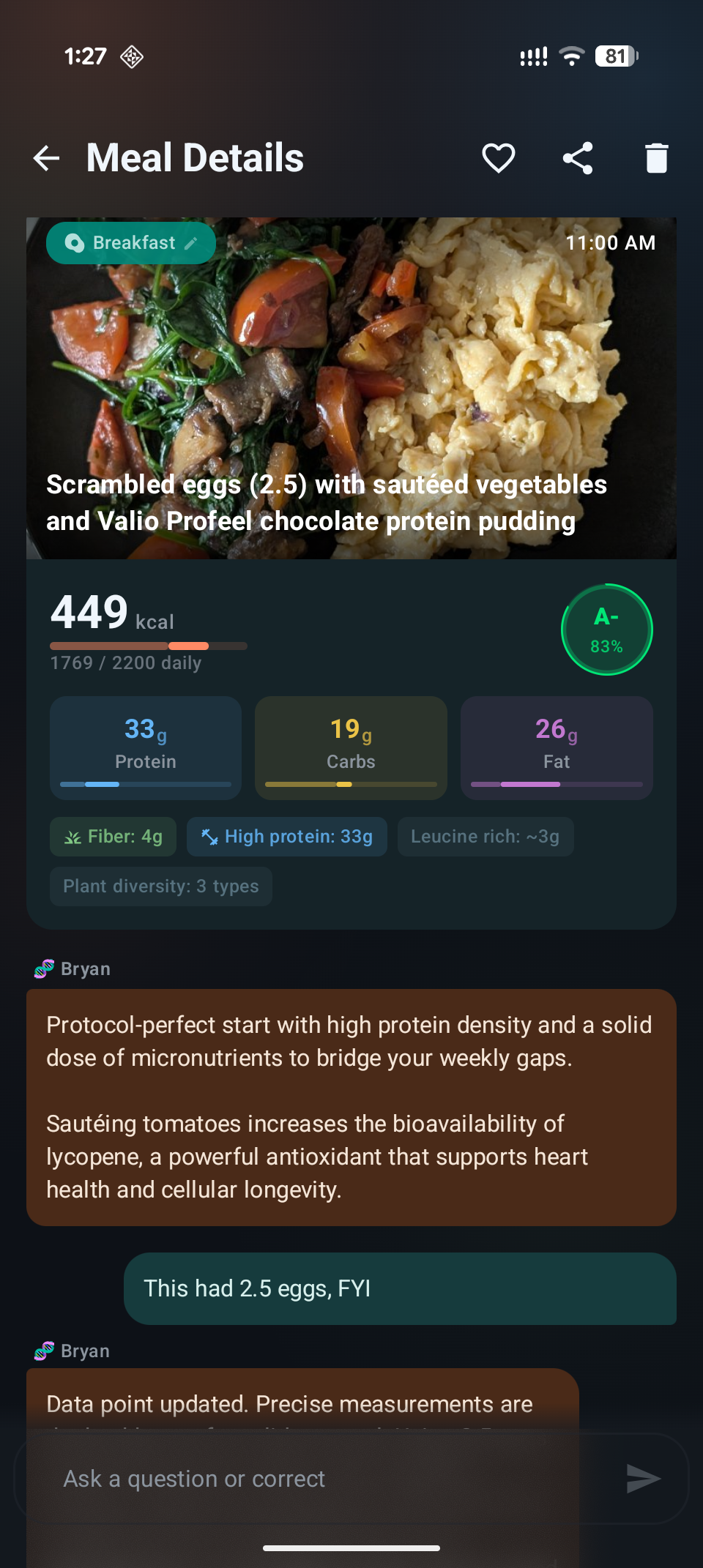
Protein density is the primary signal. Grams of protein per 100 calories. This single ratio tells us more about meal quality than almost anything else. At 8g+ per 100 kcal, your meal is doing serious work. 5-8g is good. 3-5g is adequate. Below 3g, the meal is mostly filler.
Why density and not just total grams? Because a 600-calorie meal with 30g of protein is fundamentally different from a 300-calorie meal with 30g. The smaller meal is twice as efficient. Density measures quality in a way that raw totals can't.
Food quality follows a defined rubric. This isn't subjective. We use specific deductions and bonuses so the system is consistent and transparent.
On the deduction side: ultra-processed foods (NOVA Class 4) take a significant hit, up to 40 points for a meal built entirely around processed ingredients. Added sugar above 15g, trans fats, seed-oil frying, and alcohol all carry defined penalties. But here's the key: deductions are proportional. A splash of hot sauce in an otherwise whole-food meal barely registers. A frozen pizza as the entire meal gets the full deduction. The system weighs how much of the meal is processed, not just whether processing exists.
On the bonus side: wild-caught fish, pasture-raised eggs, fermented foods like kimchi or kefir, extra virgin olive oil, high fiber, and organic Dirty Dozen produce all earn small bonuses. These are rewards, not requirements. We don't penalize you for buying conventional produce. We give a small nod when you go the extra mile.
Protocol fit ties it together. Your personal protocol includes food rules: things to avoid, things to prioritize, portion guidelines. The scoring system checks your meal against those rules. A meal that follows your protocol's priorities earns a higher base score than one that ignores them, even if the raw macros look similar.
Treats are different
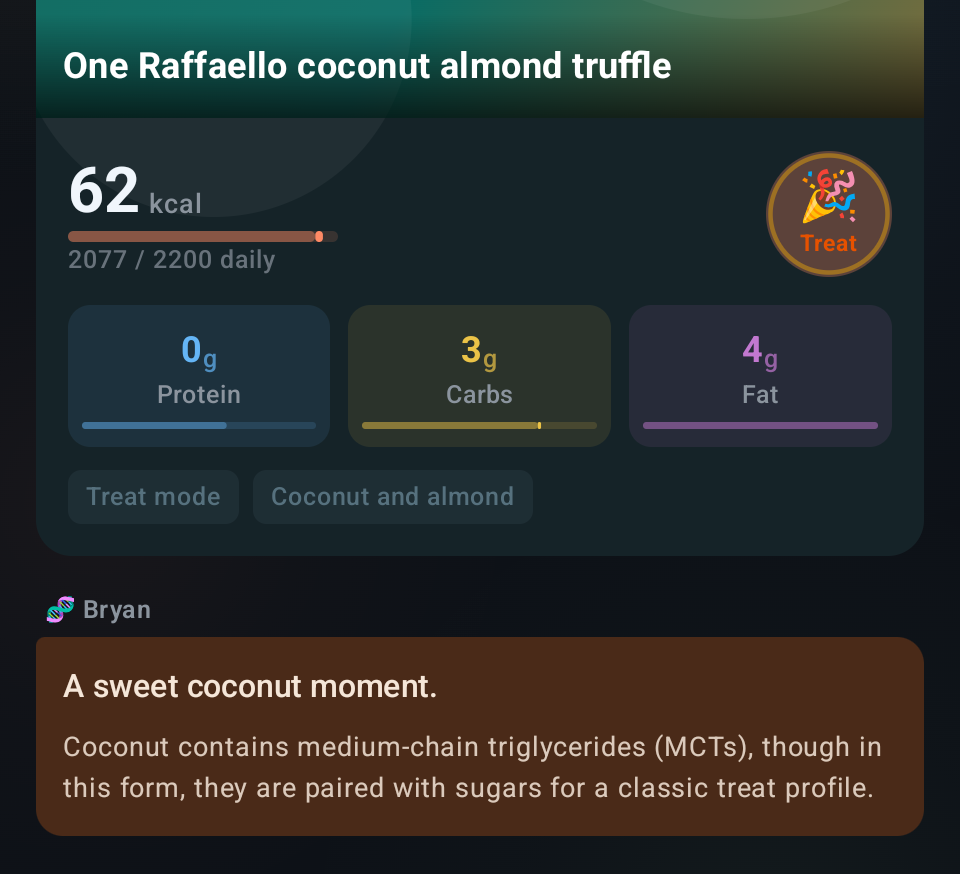
Mark a meal as a treat and the scoring system steps back. No grade. No penalty. No impact on your daily average.
This is deliberate. A birthday dinner, a weekend brunch with friends, a bowl of ice cream on a Tuesday because you wanted one. These aren't failures. They're life.
The system tracks treats so you have a complete picture of your week. But it doesn't judge them. You told it this was a treat. It respects that.
I added this feature because I kept marking my Friday night sushi as a "cheat meal" in other apps and hating how it looked on my dashboard. It wasn't a cheat. It was dinner with my wife.
It's personal
The same meal can score differently for two different people. That's not a bug. That's the point.
Your protocol defines your targets, food rules, and commitment level. A keto user and a balanced-diet user eating the same salmon plate get different grades because the system evaluates each meal in context. How does this meal serve this person's goals?
GLP-1 users get additional calibration. Since up to 40% of weight lost on GLP-1 can be lean mass, protein density becomes even more critical. The system never penalizes small portions when density is high. A 200-calorie meal with 25g of protein (12.5g per 100 kcal) is exceptional, and the scoring reflects that.
Why not just count calories?
Calories measure quantity. Grades measure quality and context together.
A 500-calorie fast-food meal and a 500-calorie salmon bowl with roasted vegetables are not the same meal. Radically different protein densities, micronutrient profiles, processing levels. A calorie counter treats them as identical. Our scoring system knows the difference.
Calorie volume matters, but it's a daily-level concern. Your daily summary handles that by looking at totals across all meals. Individual meal scoring focuses on composition: what you chose and how it's put together. A 300-calorie meal of prawns and broccoli with excellent protein density scores the same as a 600-calorie version with the same composition. Quality doesn't change with portion size.
Grades that actually help
The point of a grade isn't to make you feel good or bad. It's to give you a fast, honest signal about whether a meal is working for your goals.
Over time, those signals compound. You notice which meals consistently land in the A range. You develop an intuition for protein density without calculating it. You reach for the wild-caught salmon instead of the processed alternative, not because an app shamed you, but because you've seen the difference in your scores.
That's the system working as designed. Not rigid enforcement. Not calorie arithmetic. Clear, consistent feedback that meets you where you are.
Like our approach?
MyProtocol scores your meals, coaches you in real time, and adapts to your goals. Get started in two minutes.
