Why Calories Are a Range, Not a Target
I spent years chasing a number. 2,100 calories. That was my target. Some days I'd hit 2,130 and feel guilty about those 30 extra calories. As if my body operates with the precision of a chemistry lab.
It doesn't. Nobody's does.
The false precision problem
Your metabolism isn't a fixed number. It fluctuates by 5-10% daily based on sleep quality, stress, hormonal cycles, how much you fidgeted, and whether you took the stairs. A TDEE calculator gives you a reasonable estimate. That's all it is. An estimate.
When a tracker sets a rigid target of 2,100 calories, it creates a binary. You hit the number or you didn't. Come in at 2,150 and you see red. Land at 1,950 and you're "under target." Both outcomes feel like failure. Neither matters.
This kind of thinking breeds anxiety. Every meal becomes math. Every day becomes a test you can fail. That's not sustainable. And unsustainable systems don't produce results. They produce burnout.
I know because I burned out three times before figuring this out.
The range approach
MyProtocol doesn't give you a single calorie target. It defines a caloriesMin and a caloriesMax for every user. Anywhere inside that range is success. Not "close enough." Success. Full stop.
The width depends on a commitment level you choose:
- Starter (85-110% of baseline): The widest range. You're building habits, learning what works. A 2,000-calorie baseline becomes roughly 1,700-2,200. Plenty of room to live your life while staying on track.
- Committed (85-105%): Tighter, for users who want noticeable results. Same baseline becomes 1,700-2,100. Still flexible.
- Optimized (90-102%): The strictest level. For people who want everything dialed in. Narrows to roughly 1,800-2,040. Demanding, but you chose it.
You pick your own level of strictness. You can start wide and tighten over time. Nobody is forced into a precision they're not ready for.
Why this works psychologically
Binary thinking is the enemy of consistency. When you have a single target, every day is pass or fail. Once you "fail," even marginally, the temptation is to write off the whole day. One slice of pizza becomes a whole pizza because you already "blew it."
Research on goal-setting theory consistently shows that range-based goals reduce anxiety and increase persistence compared to single-point targets. A range eliminates the spiral. A day at 95% is a win. A day at 102% is also a win. Both are green. Both build momentum.
There's also a floor. The lower bound sits at 85-90%. This prevents chronic undereating, which is a real and underappreciated problem. Consistently eating too little triggers metabolic adaptation, muscle loss, and hormonal disruption. Studies on prolonged caloric restriction show metabolic slowdown that persists long after the diet ends. If your intake drops below the floor for several days running, MyProtocol flags it. Gently, not with shame. Because under-fueling is just as much of a problem as over-fueling.
How it works in practice
When you log a meal, MyProtocol doesn't score it against a calorie target. Individual meals are evaluated on composition: protein density, food quality, how well they fit your protocol. Calorie tracking happens at the daily level, where it actually makes sense.
At the end of the day, your total intake is compared against your range. Say your baseline is 2,000 and you're on Starter. Your success zone is 1,700 to 2,200. You ate 1,850 today? Green. Not "under target." Green. You're in the zone.
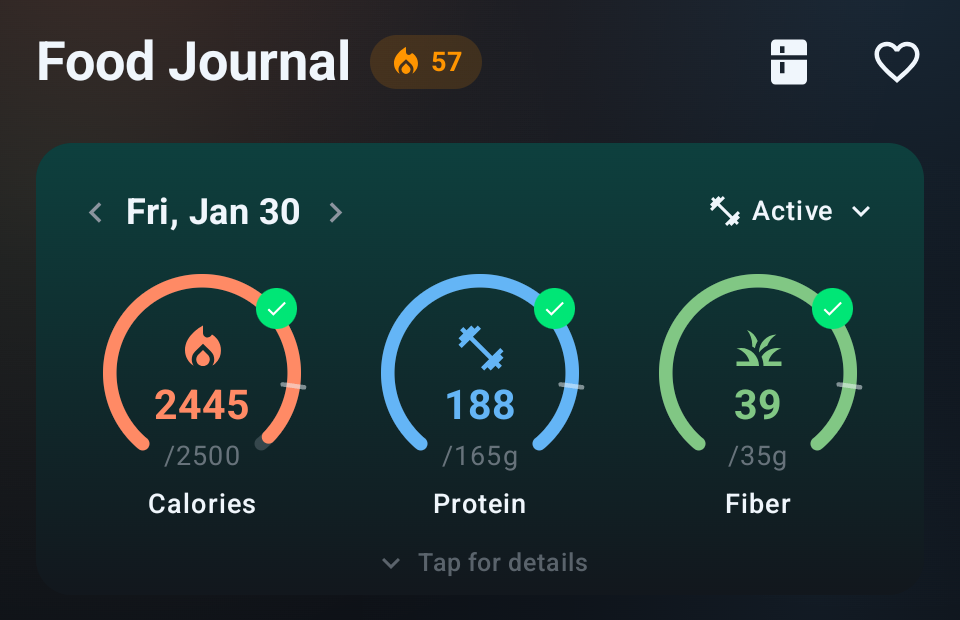
A 2,150-calorie day and a 1,750-calorie day score the same way. Both within range. Your body naturally varies its hunger signals. A system that respects that variation instead of fighting it is a system you can actually stick with.
Built for real life
You'll have days where stress kills your appetite and days where a long hike leaves you starving. You'll have celebrations, travel, and weeks where nothing goes according to plan.
A single calorie target treats all of those days as failures waiting to happen. A range treats them as what they are. Normal human variation. That's one of the core ideas behind MyProtocol. The best nutrition system is one that helps you course-correct and feel accomplished, even on imperfect days.
Because imperfect days are most days. And they're more than good enough.
Like our approach?
MyProtocol scores your meals, coaches you in real time, and adapts to your goals. Get started in two minutes.
